Themes
A Theme is a genre, not a palette.
Jazz is not a set of notes. It is a history, a theory of harmony, a way of phrasing, rules its masters broke on purpose, and a canon you can point at. A Theme is that for design: a way of seeing with its own reasons, deep enough that a person or a model can follow it and make something that belongs to it without copying anything already made.
Themes are many and meant to disagree. A Theme that cannot defend itself against the others has not been built yet. Each one carries:
- its lineage, read from primary sources and marked read or unread;
- its principles, each with the reason behind it;
- its system: colour, type, space and motion, as tokens;
- where it breaks its own rules on purpose;
- its work, judged against it;
- what it is not.
Chloroflux
A living green on a green-cast paper. Sans-led and measured. It names its sources as Munari's economy and useful play, Bauhaus production discipline, and the Swiss reduced language.
Its system
F4F8F0
12231B
5B6B61
2E7D46
One voice, the sans, for everything from a label to a hero line; an 8 pt base with 4 px for fine adjustment.
Its work
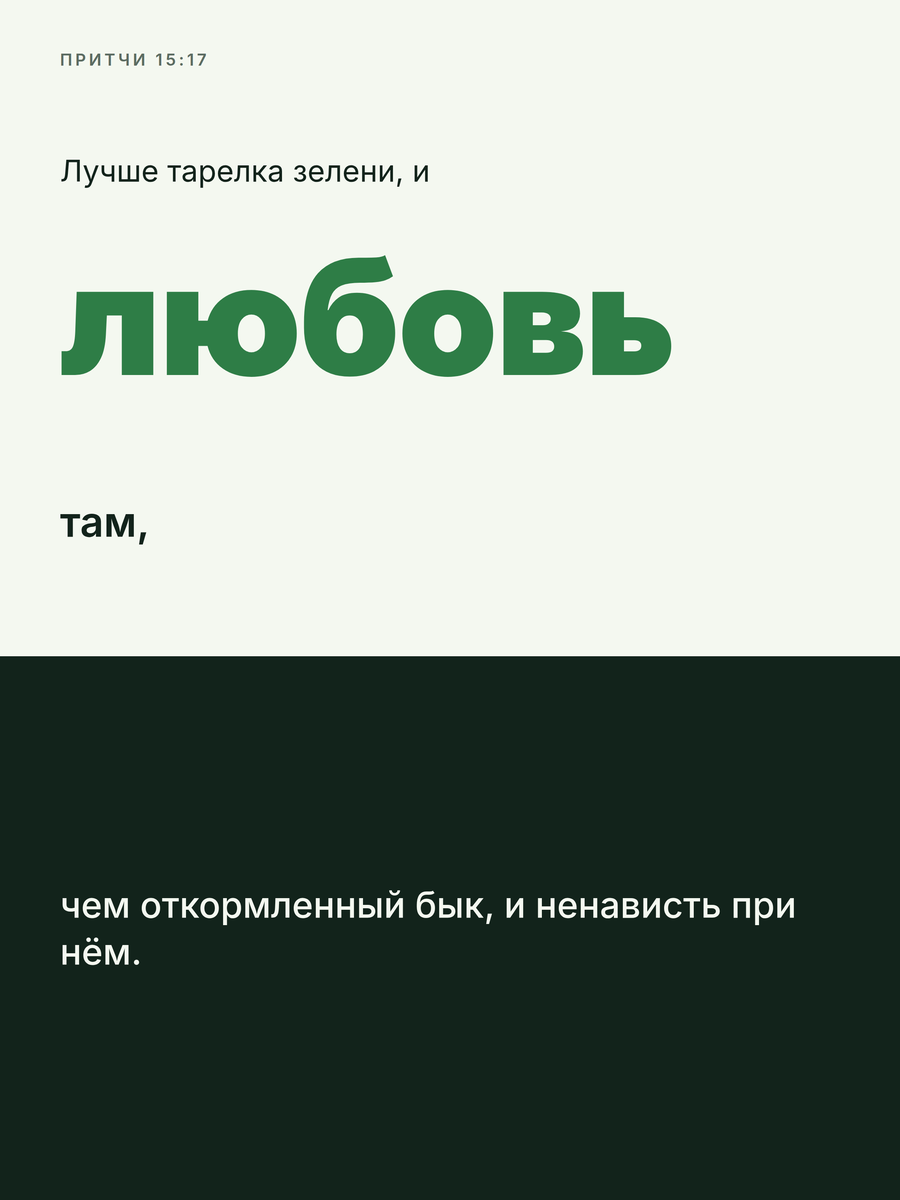
Six verse cards, September 2026. One word carries the green, and it is the word the verse turns on.
Its debts
A Cyrillic face of its own, which it does not have yet. And its theory: today it is two files of tokens and three named sources, not yet a genre.
The Device Formula
form ever follows function, and this is the law
Louis H. Sullivan, “The Tall Office Building Artistically Considered”, Lippincott's Magazine, March 1896, pp. 403–409
The law applied to every dimension a work has: the form of sound, of time, of colour and of shape, each following its function. That reach is this Theme's extension of the law and is not Sullivan's sentence. This Theme is a draft.
Its lineage
- Sullivan, 1896, read whole.
- Munari, Design as Art, read at pp. 32 and 34:
The space around the disc isolates the image from any other near-by forms.
- Vignelli, The Canon, read at pp. 72 and 92:
In a world where everybody screams, silence is noticeable. White space provides the silence.
The rest of both books is unread, and nothing is quoted from it.
Its principles
- Name the function before the form. Life
seeks and takes on its forms in an accord perfectly responsive to its needs
(Sullivan), so the need comes first. Where a work has no natural need to obey, the need is named in words a stranger could test, or the form has nothing to follow. A form that serves no named function is decoration with a citation. - Design the part knowing the whole it joins.
The left hand side must know what the right hand is doing, the top must know the bottom
(Munari, p. 34). A part designed without its neighbours meets them by accident. - Spend attention deliberately.
The eye is attracted by the dark disc and has no way of escaping
(Munari, p. 32). One image isolated in its space, exactly the information needed, no second voice assaulting the first. Every surface answers: where does the eye land, and why there.
OPEN Four further principles, on imperfection made on purpose, on measurement, on calibration as a repeating chain, and on sound, stand on no source read yet. Each earns a primary, quoted and page-cited, or it goes.
Its system
- Name the function before the form; the name is the test of every later decision.
- Isolate the image: one thing in its space, nothing near it competing.
- Design the landing: the eye goes where the work sends it, and stays there because nothing assaults it.
- One or two type sizes at the most. Enlarging type to make a message louder is what Vignelli calls
intellectual vulgarity
. - White space is
the significant silence to better hear their message loud and clear
(Vignelli).
Where it breaks its own rules
The law is not a machine. Sullivan's own examples are living things, the blithe swan, the
branching oak
, shaped by no plan. So the named function may be revised mid-work and the form
follows again, openly, said so in the work's notes. A Theme that cannot say “the function
changed” is a template wearing the law as a costume.
What it is not
Not a palette or a look: it is a law applied to decisions. Not a Bauhaus inheritance: that claim appears in nothing read here. Not “calculate everything and the function takes care of itself”: the function comes first precisely to refuse that.