Ball terminal
A terminal that ends in a round blob, common on the a, c, f, r and y of old-style and transitional serifs.
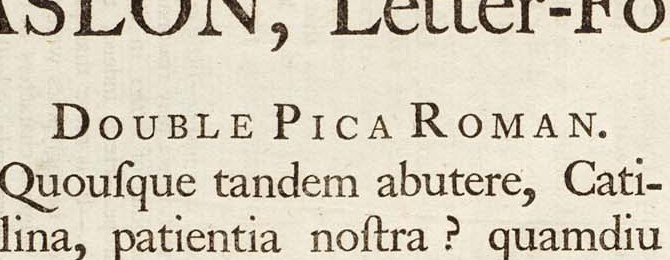
Public domain
Public domain: Caslon's broadsheet of about 1734, out of copyright everywhere since Caslon died in 1766; Commons tags the file public domain and a faithful photograph of a flat sheet carries no new copyright; this crop is the Double Pica roman, the largest text size on the sheet.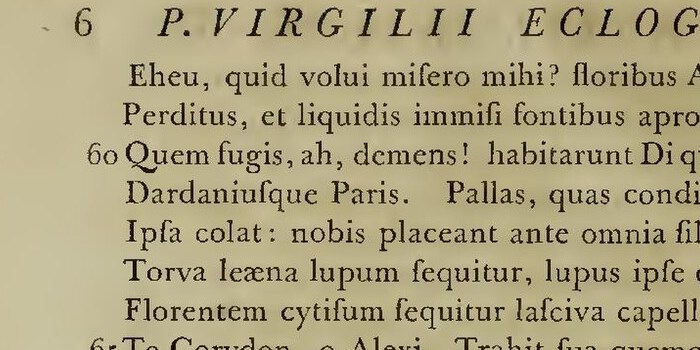
Public domain
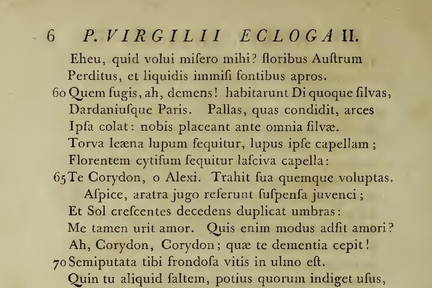
Public domain: Baskerville's Virgil of 1757, out of copyright everywhere since Baskerville died in 1775; Commons tags the scan public domain and a faithful scan of a flat page carries no new copyright; this crop is the upper half of the page.
Public domain
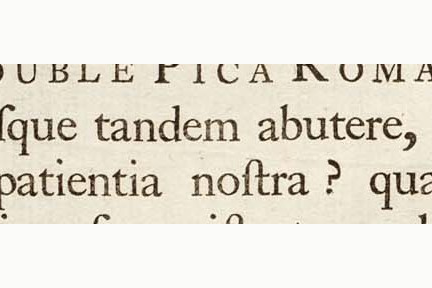
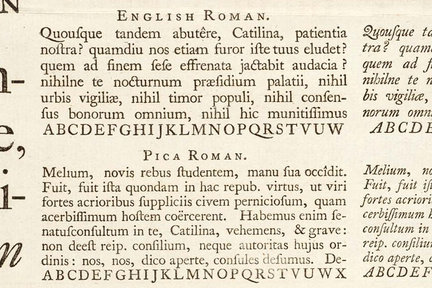
Public domain: Printed in Paris in 1766 by Fournier, who died in 1768; out of copyright everywhere; Commons tags the file public domain, and this house reads a faithful reproduction of a flat public-domain page as carrying no new copyright.Near it
 Terminal
 Finial
 Garalde
 Transitional

What it is made of
| what it is | a terminal that swells into a disc, as on an a, c, f, r or y in many text faces | |
| measured from the source, and the measurement is a nil | there is not one and there cannot be | a stroke in this foundry carries a SINGLE SCALAR w. There is nowhere in the data to write a width that changes along a stroke, so this cannot exist here and its absence is the engine rather than an omission. read from the shelf's own stroke data rather than measured off its ink |